Solid Angle
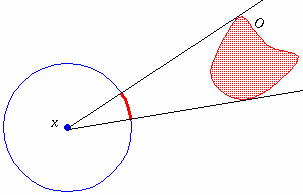
Recall from 2D than the angle subtended by an object, O, from a point, x, is the length of the projection of O onto a unit circle centred at x. It is measured in "unit angles", or radians (rad). The full circle subtends $2 \ \pi$ radians.
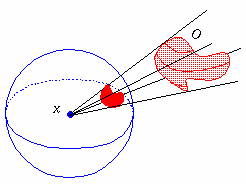
In 3D, the angle subtended by an object, O, from a point, x, is the area of the projection of O onto a unit sphere centred at x. It is measured in "unit solid angles", or steradians (sr). The full sphere subtends $4 \ \pi$ steradians.
Measures of Illumination
Radiant power ($P$) is the rate at which light energy is transmitted, and is measured as energy (photons) per unit time, in Watts.
Power at a Point
Flux is the radiant power crossing a particular surface.
Flux density ($\Phi$) is the radiant power per unit area of the surface, measured in Watts per unit area. At a point, $x$, surrounded by an infinitesimal surface, $dx$, the flux density is $$\Phi(x) = \frac{dP}{dx}.$$
Incident flux density is the flux density of particles arriving at a surface from all directions. It is also called irradiance (E).
Exitant flux density is the flux density of particles leaving a surface in all directions. It is also called radiosity (B).
Power in a Direction
Consider a point light source. Its radiant intensity (I) is the power radiated per unit solid angle, and is measured in Watts per steradian.
In a particular direction, $\omega$, surrounded by an infinitesimal solid angle, $\domega$, the radiant intensity is $$I(\omega) = \frac{dP}{\domega}.$$
Power at a Point, in a Direction
Radiance (L) is the flux density at a point, $x$, in a direction, $\omega$. Sometimes, the direction is given by two angles: inclination $\theta$ (from the surface normal, $n$) and azimuth $\Phi$ (from a given direction on the surface).
The flux density is measured with respect to a surface perpendicular to the direction. If the surface at $x$ is not perpendicular to direction $\omega$, it is projected onto a surface that is.
The figure below shows the radiance at $x$ as the flux density across the surface $dx'$ in the direction $\omega$:
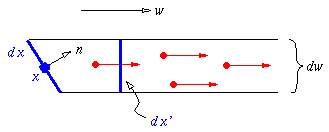 $$L(x,\omega) = \frac{d P}{\domega \ dx'}.$$
Since the ratio of the areas, $dx'$ and $dx$, is $\cos \theta$ (where $\theta$ is the angle between $\omega$ and $n$, the surface normal at $x$), radiance is typically written as
Reflection and BRDFs
[Sillion & Puech 2.1.4]
The bidirectional reflectance distribution function at a point, $x$, is the ratio of the radiance going out in one direction to the flux density coming in from another direction.
Let $\omega_i = (\theta_i,\phi_i)$ and $\omega_o = (\theta_o,\phi_o)$ be the incoming and outgoing directions, respectively.
The incoming directional flux density, $\Phi_i$, is the flux density of energy arriving from an infinitesimal solid angle, $\domega_i$, around $\omega_i$. From the radiance equation, $$\begin{array}{rcl} \displaystyle{\frac{d P}{dx}} &=& L(x,\omega) \ \cos \theta \ \domega \\ &=& \Phi. \end{array}$$
The flux density, $\Phi$, is taken with respect the the infinitesimal solid angle, $\domega$. The BRDF is then $$\begin{array}{rcl} \rho_{BD}(\omega_o,\omega_i) &=& \displaystyle{\frac{L_o(x,\omega_o)}{\Phi_i}} \\ &=& \displaystyle{\frac{L_o(x,\omega_o)}{L_i(x,\omega_i) \ \cos \theta_i \ \domega_i}}. \end{array}$$
Note that the units of the BRDF are per steradian. The reflected radiance due to radiance incoming from a particular direction is $$ L_o(x,\omega_o) = \rho_{BD}(\omega_o,\omega_i) \ L_i(x,\omega_i) \ \cos \theta_i \ \domega_i. $$
BRDFs and Lambertian Surfaces
A Lambertian surface, or "ideal diffuse surface", has a constant BRDF: $$ \rho_{BD}(\omega_o,\omega_i) = \rho_{BD}. $$
The radiance of such a surface is independent of direction. The total outgoing radiance in a particular direction, $\omega_o$, is the integral of reflected radiance from all incoming directions, $\Omega$: $$\begin{array}{rcl} L(x,\omega_o) &=& \displaystyle{ \int_{\Omega} \rho_{BD}(\omega_o,\omega_i) \ L_i(x,\omega_i) \ \cos \theta_i \ \domega_i } \\ &=& \displaystyle{ \rho_{BD} \ \int_{\Omega} L_i(x,\omega_i) \ \cos \theta_i \ \domega_i } \\ &=& \rho_{BD} \ E(x) & \text{(recall irradiance, E(x)).} \end{array}$$
How are radiosity and irradiance related for a Lambertian surface? $$\begin{array}{rcl} B(x) &=& \displaystyle{ \int_{\Omega} L_o(x,\omega) \ \cos \theta \ \domega } \\ &=& \displaystyle{ \int_{\Omega} \rho_{BD} \ E(x) \ \cos \theta \ \domega } \\ &=& \displaystyle{ \rho_{BD} \ E(x) \ \int_{\Omega} \cos \theta \ \domega } \\ &=& \displaystyle{ \rho_{BD} \ E(x) \ \pi } \\ \end{array}$$
Inuitively, the quantity $\rho_{BD} \ \pi$ is the fraction of irradiance, $E(x)$, that is reflected (as radiosity, $B(x)$). This quantity is known as the albedo ($\rho$): $$ \rho = \pi \ \rho_{BD}. $$
Then
How are radiosity and outgoing radiance related for a Lambertian surface? $$\begin{array}{rcl} B(x) &=& \rho \ E(x) \\ &=& \rho \ \left( \frac{L(x,\omega_o)}{\rho_{BD}} \right) \\ &=& \pi \ L(x,\omega_o). \end{array}$$